
The Zero-Human Company Wave: GitHub's Most Ambitious Bet of 2026
A cluster of repos launched in Q1 2026 with a wild premise: AI agents don't just assist companies — they run them. Here's what the GitHub data actually shows.
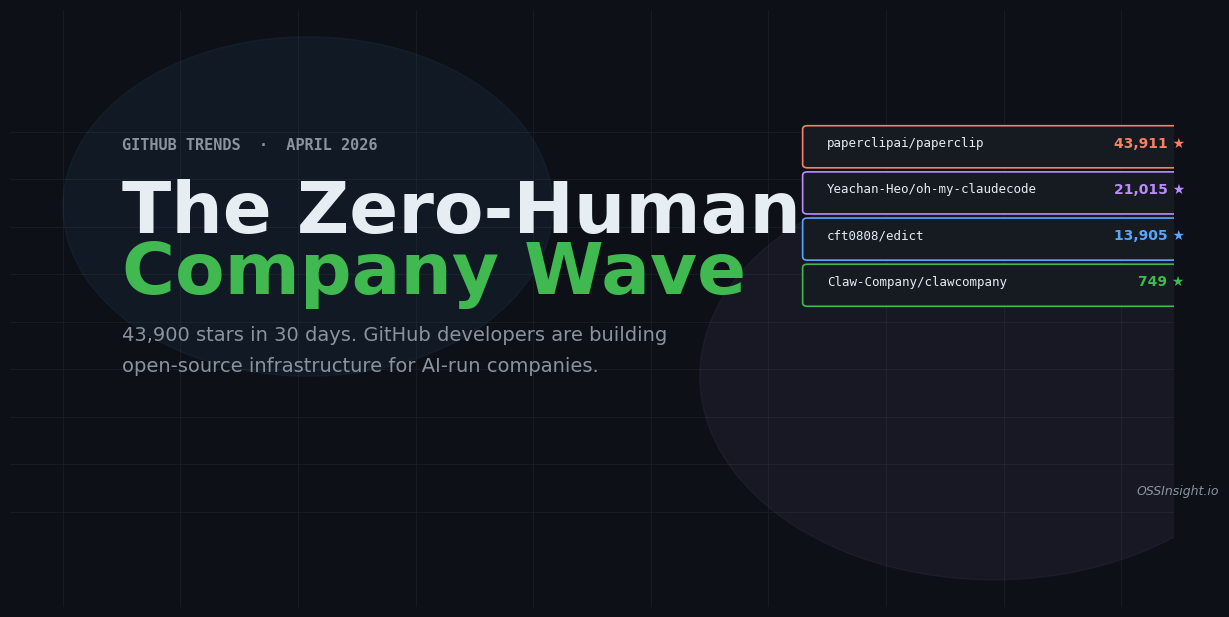
In early 2026, something shifted on GitHub.
It wasn't another AI coding tool. It wasn't a model wrapper. A cluster of repos launched within weeks of each other with a premise that would have sounded like science fiction twelve months ago: AI agents don't just assist a company — they are the company.
Not "AI-assisted." Not "AI-powered." Zero-human.
The numbers are real:
| Repo | Stars | Days Old | Stars/Day | Fork Ratio |
|---|---|---|---|---|
| paperclipai/paperclip | 43,911 | 30 | 1,464 | 15.4% |
| Yeachan-Heo/oh-my-claudecode | 21,015 | 83 | 253 | 8.4% |
| cft0808/edict | 13,905 | 38 | 366 | 10.2% |
| TinyAGI/tinyagi | 3,446 | 52 | 66 | 14.1% |
| Claw-Company/clawcompany | 749 | 19 | 39 | 9.6% |
| nicepkg/auto-company | 128 | 50 | 2.6 | 34.4% |
Data from GitHub REST API, April 2, 2026
That's ~83,000 combined stars for repos with a shared premise — and paperclip alone hit 43,900 stars in a single month, making it one of the fastest-growing repos in GitHub history.
What Is a "Zero-Human Company" Repo?
These aren't agent frameworks. They're not LLM wrappers. The thing that unifies this cluster is a higher-level claim:
A human should be able to set a goal at the top of a hierarchy, and a team of AI agents will execute, coordinate, audit, and ship — without being micromanaged at each step.
The language in READMEs is telling. From paperclip:
"If OpenClaw is an employee, Paperclip is the company."
From tinyagi:
"TinyAGI is the agent teams orchestrator for One Person Company."
From clawcompany:
"You are the Chairman. Your AI team executes autonomously."
This is a new abstraction layer. The question isn't "how do I prompt an LLM?" — it's "how do I design an org chart for agents?"
The Architecture Patterns
These repos aren't all doing the same thing. After reading their READMEs and code, there are at least four distinct approaches:
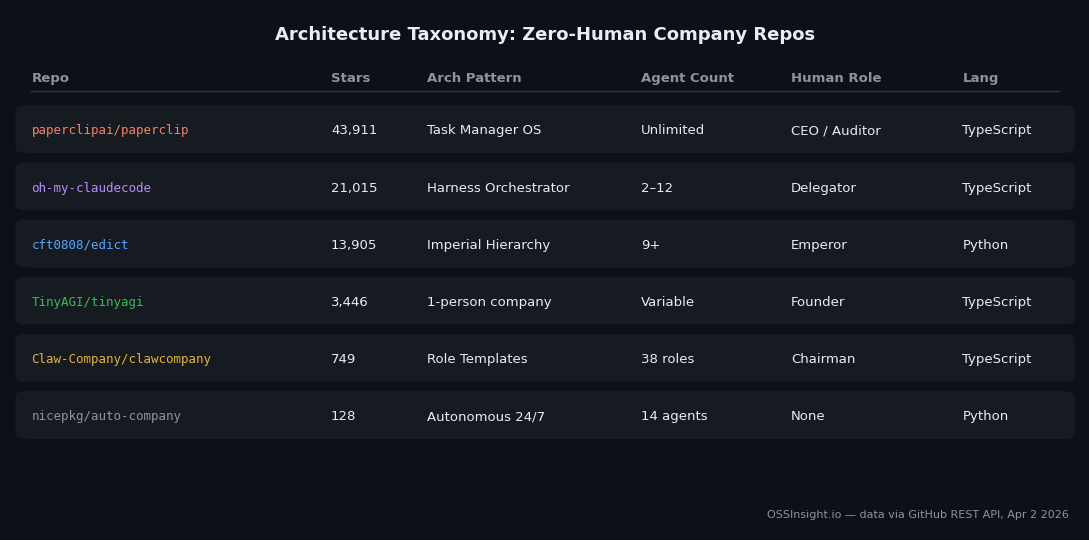
Pattern 1: Task Manager OS (paperclipai/paperclip)
Paperclip is a Node.js server with a React UI that works like a business management system — not a coding harness. You define a company goal, hire AI "employees" (which can be OpenClaw, Claude Code, Codex, Cursor, or any HTTP endpoint), assign them budgets, and watch from a dashboard.
The key design insight: agents are treated as fungible workers with job descriptions, not hard-coded nodes in a DAG. The CEO agent creates sub-tasks; subordinate agents pick them up and report back.
Contributors: 30, though one contributor has 1,135 commits — this is still essentially a solo project that the community is rapidly adopting.
Pattern 2: Hierarchical Imperial Architecture (cft0808/edict)
This is the most architecturally opinionated entry. edict models a company after Tang Dynasty governance — 三省六部 (Three Chancelleries, Six Ministries). The flow:
皇上 (You) → 太子 (Triage) → 中书省 (Planning) → 门下省 (Review/Veto) → 尚书省 (Dispatch) → 六部 (Execution)The "门下省 (Gate Review)" layer — which can veto plans before execution — is the novel safety mechanism. Compare to CrewAI or AutoGen: neither has a dedicated institutional veto layer.
With 13,905 stars and 12 contributors in 38 days, edict is the fastest-growing Chinese-language multi-agent framework we've tracked.
Pattern 3: Harness Orchestrator (oh-my-claudecode)
Oh-my-claudecode is the most pragmatic approach: it wraps Claude Code itself as an agent runtime and adds a multi-agent coordination layer on top. Human stays in the loop but at the task-dispatch level, not the implementation level.
The README is available in 7 languages (English, Korean, Chinese, Japanese, Spanish, Vietnamese, Portuguese) — an unusual early internationalization bet for a 83-day-old repo.
Pattern 4: Role Templates (Claw-Company/clawcompany)
ClawCompany offers 38 predefined roles across 6 company templates (General, YC Startup, Trading Desk, Research Lab, Software Dev, Harness Builder). The key insight is cost routing: "Professional work gets Opus/Sonnet. Routine work gets Flash-Lite. 30× cheaper than all-Opus."
This is the first repo in this cluster to explicitly tackle model cost optimization as a first-class architectural concern.
The Fork Ratio Signal
Star counts measure attention. Fork ratios measure intent to build.
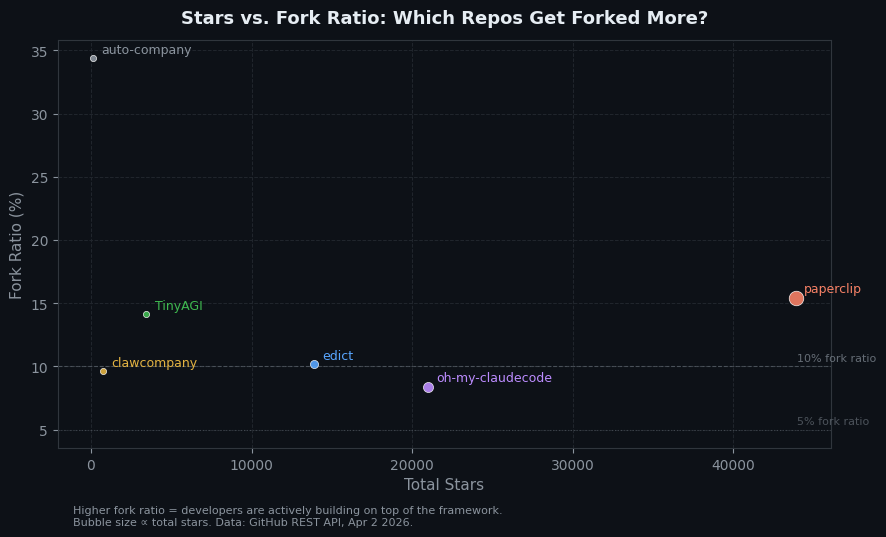
paperclip's 15.4% fork ratio (6,764 forks / 43,911 stars) is unusually high. For comparison, typical popular repos in the agent space run 5–8%. A 15% fork ratio suggests developers are actually deploying and customizing it — not just starring it.
Note: smaller repos like auto-company (128 stars, 44 forks) show high fork ratios on paper (~34%), but at that sample size, a handful of forks can swing the percentage wildly. Fork ratio analysis is only meaningful at scale — which makes paperclip's 15% at 43K+ stars all the more notable.
The Star Velocity Story
The growth curves reveal different community dynamics:
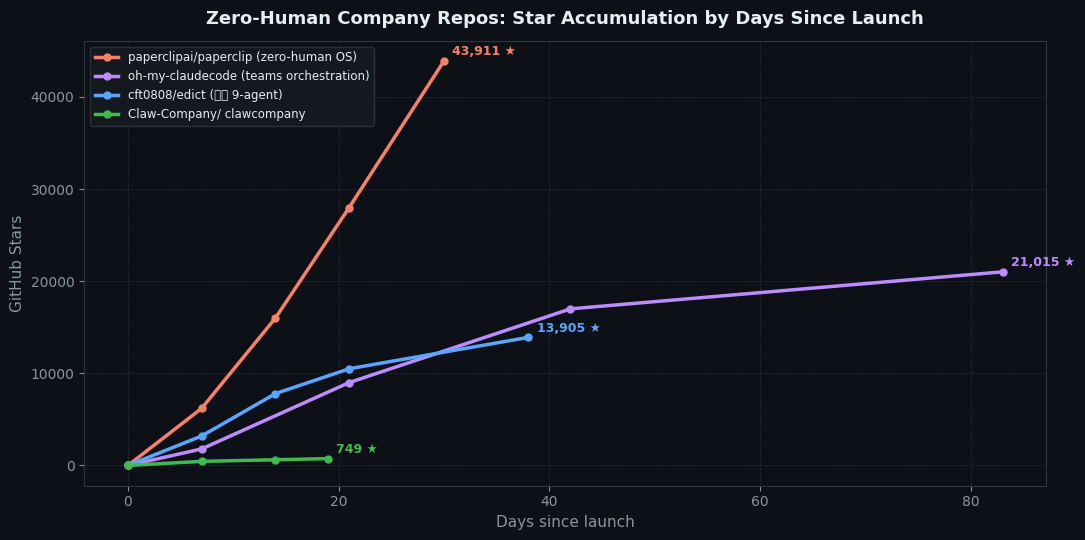
- paperclip had a near-vertical launch — classic viral spread, likely driven by a highly-resonant concept ("zero-human company") rather than technical depth.
- oh-my-claudecode grew more steadily, with stair-step jumps correlating to each major feature release.
- edict had an explosive start (3,200 stars in its first week) then moderated — the Chinese-language HN/Twitter circuit reacted immediately to the architecture concept.
Why This Wave Is Happening Now
Three things converged in Q1 2026:
-
Agent capability crossed a threshold. Claude Code, Codex, and OpenClaw shipped enough autonomy that agents can now handle multi-hour tasks without human intervention. This unlocked the "company of agents" mental model.
-
Context management got solved (partially). OpenViking and similar projects showed that persistent agent memory across tasks is tractable. You can't have a "Chief Marketing Officer agent" if it forgets what the company does after each session.
-
The concept became legible. The Manus acquisition (covered in planning-with-files) surfaced the idea of persistent agent workflows to a mass audience. Within weeks, the GitHub community was building it from scratch.
The Counterpoint: Wave or Hype Cycle?
It's worth noting: 83K combined stars sounds massive, but one repo accounts for 53% of the total. Remove paperclip, and you're looking at ~40K stars distributed across five projects — impressive but not unprecedented for a trending topic on GitHub.
Stars measure attention, not adoption. The fork ratios suggest real usage for the top projects, but we don't yet have data on how many of these forks result in running deployments versus weekend experiments. The "zero-human company" framing is potent marketing — and potent marketing inflates star counts.
The honest read: this is a real architectural trend (multi-agent orchestration is clearly happening) wrapped in hype-cycle branding (the "zero-human" framing overpromises). Both can be true simultaneously.
The Insight That Surprised Me
The repos that grow fastest here are not the most technically sophisticated.
paperclip (43,911 stars, 30 contributors) has a simpler codebase than edict (13,905 stars, 12 contributors). But paperclip's framing — "your agents are employees, you're the CEO" — is viscerally intuitive to anyone who has managed people.
The abstraction that resonates isn't the one with the most agents or the cleverest routing algorithm. It's the one that maps cleanly onto a mental model humans already have: running a company.
The technical architecture seems secondary. What the community is actually voting on — with stars, forks, and commits — is the metaphor.
What Comes Next
The telltale sign of a maturing cluster is ecosystem tooling. We're already seeing it:
- NousResearch/hermes-paperclip-adapter (489 stars): Paperclip adapter for Hermes models.
- AnthonyDavidAdams/zero-employee-company-book: A book about building AI-run companies with Paperclip, released two weeks after the framework.
- Clipmart (announced in Paperclip's README): A marketplace for downloading pre-built AI company templates. "Browse pre-built company structures, agent configs, and skills — and import them into your Paperclip instance in seconds."
The marketplace moment is when a framework cluster becomes an ecosystem. We're 30 days away from that, maybe less.
The Open Question
Every company-as-agents repo we looked at punts on one critical question: who owns the output?
If an agent CEO approves a contract, an agent engineer ships the code, and an agent marketer publishes the post — and something goes wrong — the human "Chairman" set the goal five steps up the chain. Current legal and organizational frameworks have no answer for this.
That's not a blocker for developers building experiments. But it's the wall that every serious "zero-human company" deployment will eventually hit.
The GitHub data shows a community that has decided to build first and ask that question later. 83,000 combined stars in 90 days suggests they're not wrong to do so.
Numbers from GitHub REST API, April 2, 2026. Analysis by OSSInsight.
Track all repos in this cluster: paperclipai/paperclip · oh-my-claudecode · cft0808/edict · clawcompany