
50,000 Stars for One Person's Config File: The Personal AI Stack Phenomenon
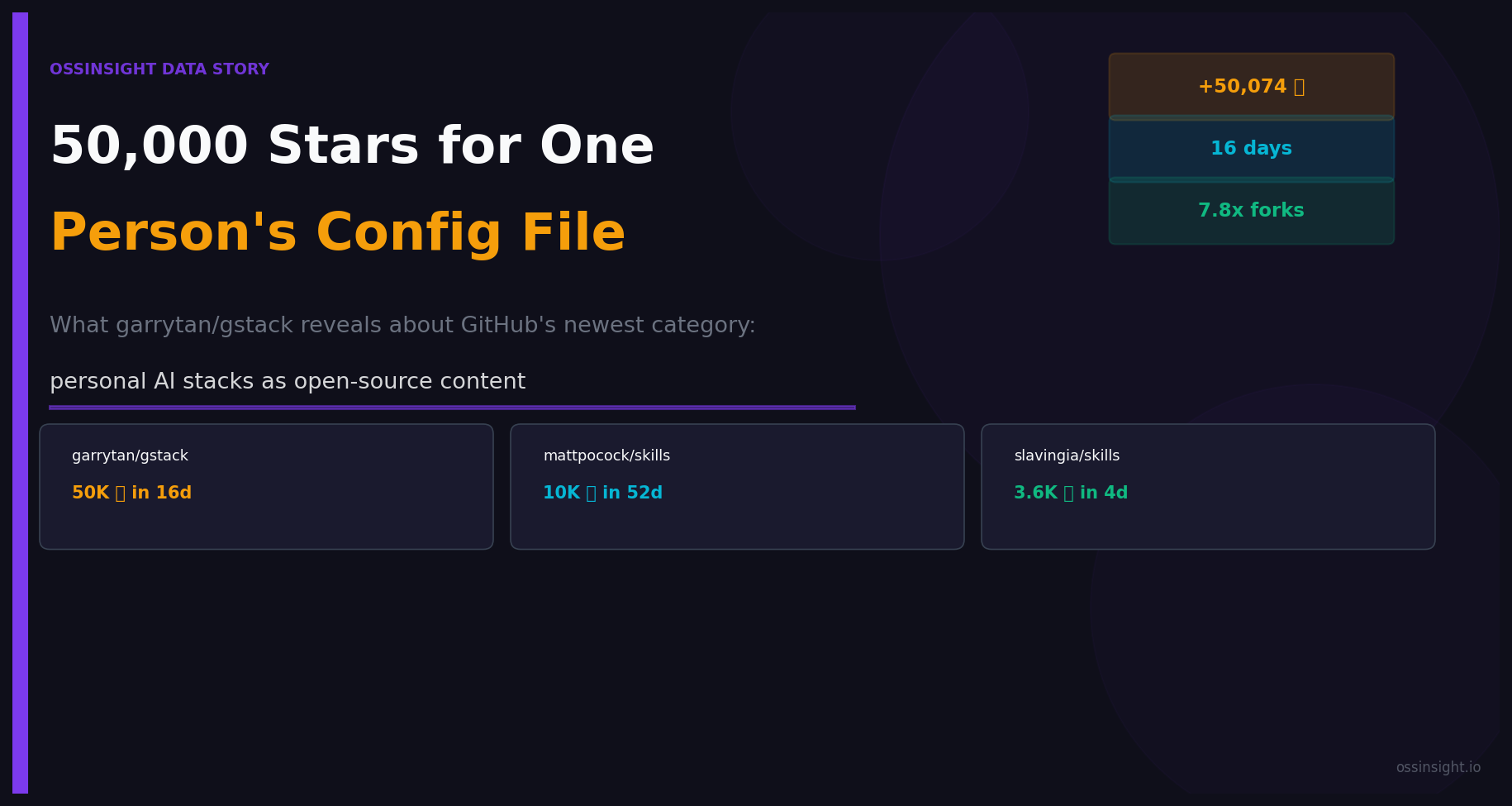
garrytan/gstack hit 50,000 GitHub stars in 16 days — for a personal AI engineering config. We analyzed the data behind this new category and found a pattern that reveals something fundamental about how developers learn in 2026.
Something unusual happened on GitHub in the past two months.
Three developers published repos containing their personal AI coding configurations — Markdown files, slash commands, system prompts — and watched them collectively accumulate 64,000+ stars.
Not code. Not libraries. Not frameworks. Config files and instructions.
garrytan/gstack hit 50,000+ stars in 16 days. mattpocock/skills crossed 10,000 stars over 52 days. slavingia/skills got 3,600+ stars in its first four days.
We analyzed the data behind all three repos to understand what's actually happening. The numbers point to something that doesn't have a good name yet.
Disclosure: OSSInsight is built by PingCAP. We have no affiliation with any projects analyzed here. All data from public GitHub APIs as of March 27, 2026.
The Repos, and the People Behind Them
To understand what's going on, you need to understand who these people are:
| Repository | Creator | Role | Stars | Created | Stars/Day |
|---|---|---|---|---|---|
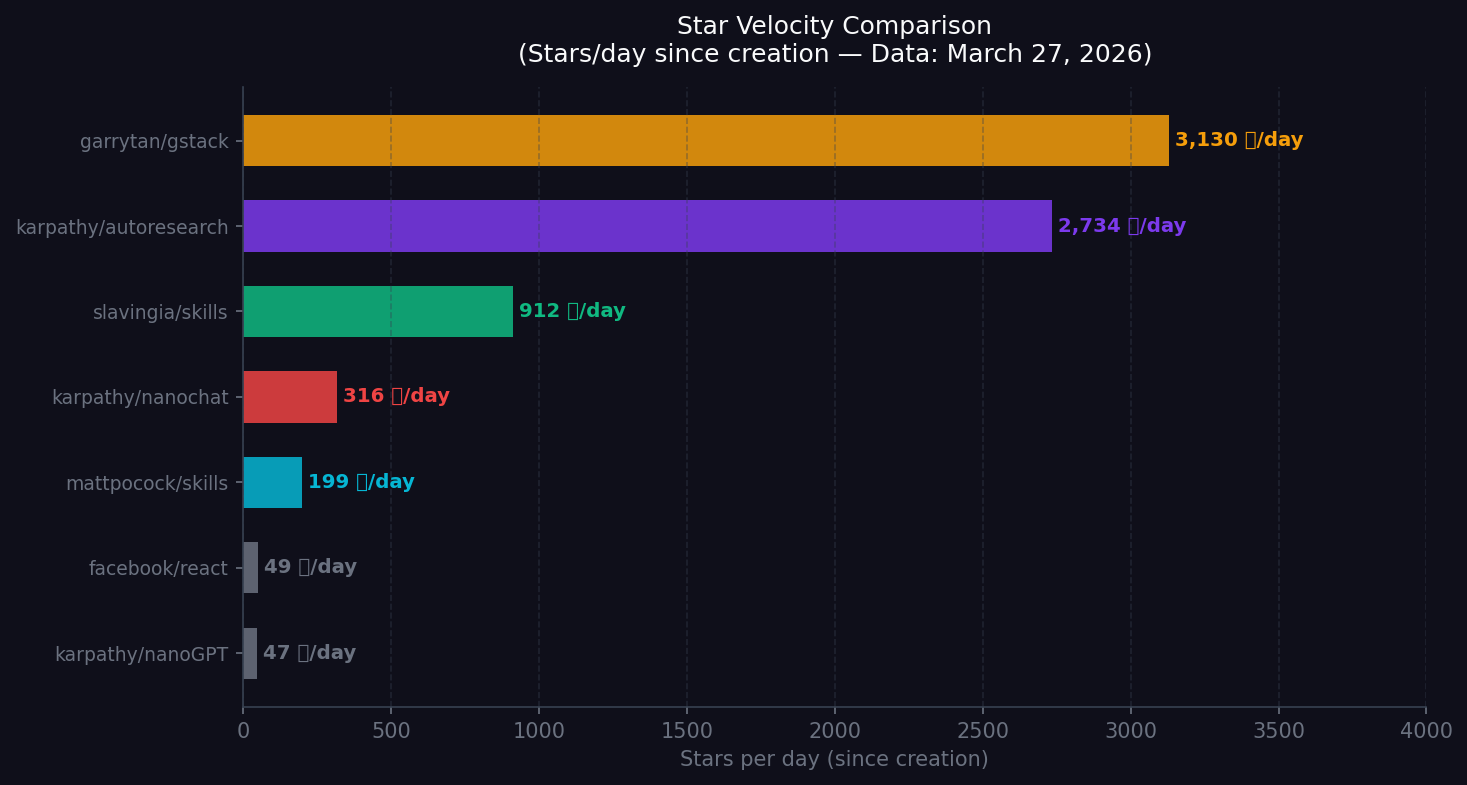
| garrytan/gstack | Garry Tan | President & CEO, Y Combinator | 50,376 | Mar 11, 2026 | 3,148 |
| mattpocock/skills | Matt Pocock | Creator of TypeScript tutorial series, author of Total TypeScript | 10,360 | Feb 3, 2026 | 199 |
| slavingia/skills | Sahil Lavingia | Founder & CEO, Gumroad | 3,675 | Mar 23, 2026 | 919 |
These are not indie hackers sharing weekend projects. These are people with established audiences, public reputations, and credibility at the intersection of technology and building companies. They're sharing how they work — not what they built.
What They Actually Are
Let's be precise about what's in these repos, because the content matters.
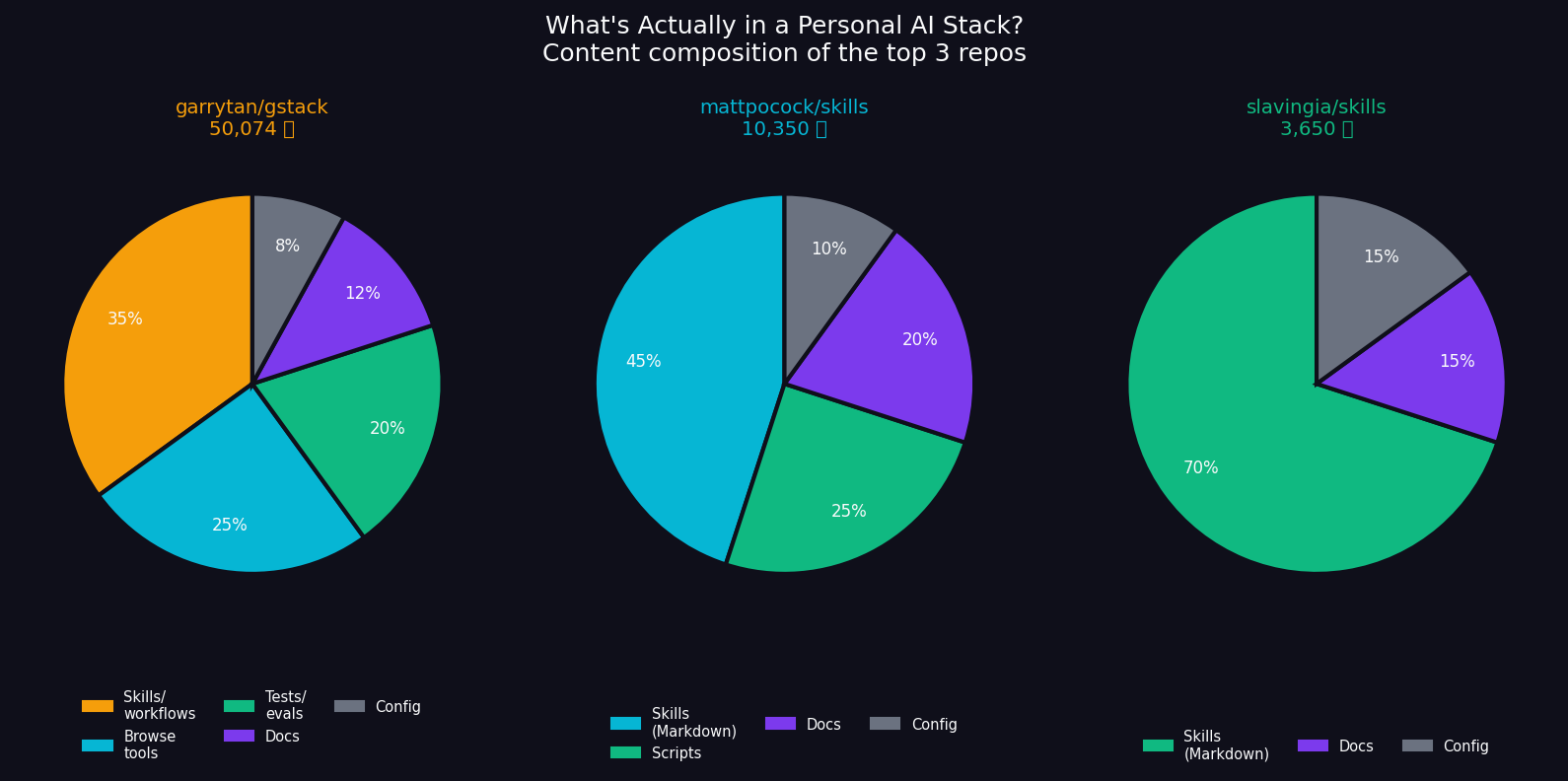
garrytan/gstack (~50K LOC across TypeScript, Markdown, tests) is the most complete. It contains 28 "skills" — slash commands that turn Claude Code into a virtual engineering team. /plan-ceo-review has an AI simulate Garry's perspective on a product decision. /review runs a multi-agent PR review: architecture check, bug scan, security audit, test coverage gate. /qa opens a real browser and tests your staging URL against a rubric. There's a headless browser CLI with E2E tests, diff-based test selection, a two-tier test system with gate vs. periodic classification.
The README opens with a quote from Karpathy: "I don't think I've typed like a line of code probably since December." Then Garry describes shipping 600,000+ lines of production code (35% tests) in 60 days — while running Y Combinator full-time.
mattpocock/skills is closer to a methodology than a tool. Skills like /write-a-prd (create a PRD through an interactive interview), /grill-me (get relentlessly interviewed about a design until every decision is resolved), /tdd (red-green-refactor loop, one vertical slice at a time). The skills are opinionated about how to think, not just how to type.
slavingia/skills is the most distilled: 10 skills that follow the arc of his book The Minimalist Entrepreneur — from finding community (/find-community) to making decisions (/minimalist-review). It's a business philosophy translated into agent instructions.
The Number That Doesn't Fit
Here's where the data gets interesting.
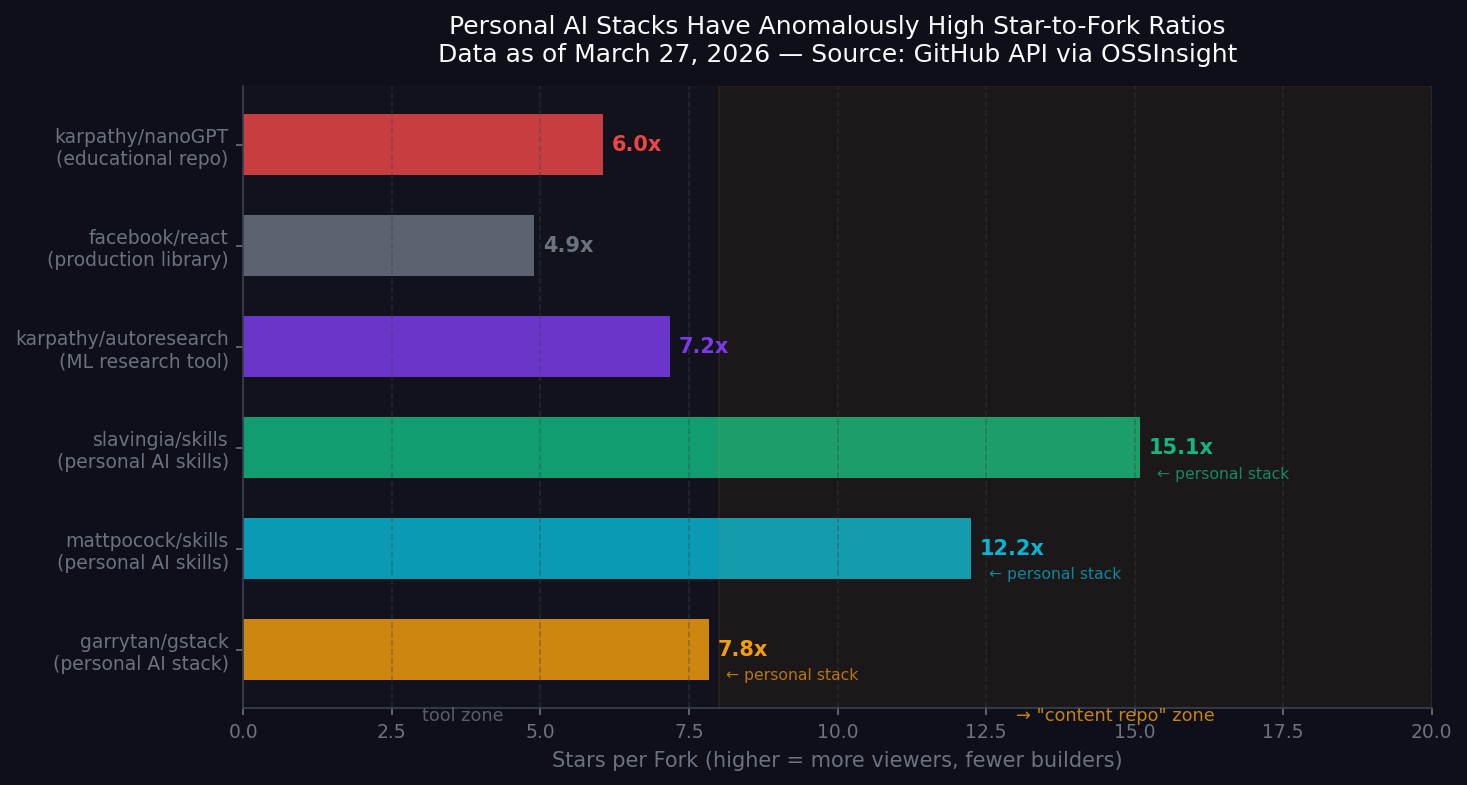
The standard way to measure whether a GitHub project is being used vs. being observed is the star-to-fork ratio. When developers star a library, a meaningful fraction of them clone and use it — they contribute bug fixes, they customize it, they fork it for their own needs. High-usage repos converge toward a ratio of 4–7 stars per fork.
Personal AI stacks sit at 8–15x.
| Repository | Stars | Forks | Ratio |
|---|---|---|---|
| garrytan/gstack | 50,376 | 6,440 | 7.8x |
| mattpocock/skills | 10,360 | 845 | 12.3x |
| slavingia/skills | 3,675 | 245 | 15.0x |
| karpathy/autoresearch | 57,540 | 8,004 | 7.2x |
| karpathy/nanoGPT | 55,646 | 9,479 | 5.9x |
| facebook/react | 244,223 | 50,861 | 4.8x |
Data as of March 27, 2026.
The ratio isn't proof of a category. But it's a signal. Stars here don't mean "I'm using this" — they mean "I want to know how this person thinks."
(You can explore these metrics yourself — try the head-to-head comparison on OSSInsight.)
The ETHOS.md Problem
One of the most revealing files in garrytan/gstack is ETHOS.md. It's injected as a preamble into every workflow skill, and it's completely unsearchable. You can't Google these principles. You can't read them in a talk or a blog post (until now). They exist only inside this repo, visible only to people who look.
The file contains a table:
| Task type | Human team | AI-assisted | Compression |
|---|---|---|---|
| Boilerplate / scaffolding | 2 days | 15 min | ~100x |
| Test writing | 1 day | 15 min | ~50x |
| Feature implementation | 1 week | 30 min | ~30x |
| Bug fix + regression test | 4 hours | 15 min | ~20x |
| Architecture / design | 2 days | 4 hours | ~5x |
| Research / exploration | 1 day | 3 hours | ~3x |
And a principle called "Boil the Lake":
"AI-assisted coding makes the marginal cost of completeness near-zero. When the complete implementation costs minutes more than the shortcut — do the complete thing. Every time."
These aren't product features. They're design philosophy. And they only exist inside a repo — not a blog, not a conference talk, not a tweet thread. GitHub has become the distribution channel for how notable builders think.
This is the thing worth naming. Call it process transparency: the practice of making your working method — not just your output — publicly available via version control.
Why GitHub, Why Now
This pattern has prerequisites that only recently converged:
1. AI coding agents that read context. Claude Code, Codex, and their peers ingest CLAUDE.md, AGENTS.md, and skill files from the repo. Your personal methodology becomes executable — not just readable. The skills in these repos aren't just documentation; they're actually running when the author codes.
2. Practitioners with public reputations. The repos are valuable because of who made them. Garry Tan's /plan-ceo-review skill is interesting because Garry Tan has sat across from thousands of founders. Matt Pocock's /tdd skill carries weight because he's taught TypeScript to hundreds of thousands of developers. The content is inseparable from the credibility.
3. Zero installation overhead. npx skills@latest add mattpocock/skills/tdd. One command. Compare this to learning from a blog post (passive), a book (slow), or a conference talk (ephemeral). With agent skills, you can adopt someone's workflow immediately and observe the results in your own codebase.
What This Predicts
The pattern is still new enough to be extrapolated. If it holds:
More notable practitioners will publish personal stacks. The ROI is hard to ignore: garrytan/gstack generated more GitHub stars in 16 days than most developer tools earn in their lifetime — and it started as an internal workflow. Once you've codified your process for your own AI agents, publishing it is a git push. Expect CTOs, staff engineers, and domain experts to follow.
The fork ratio will compress as tooling matures. Right now, most stargazers are reading, not installing. But agent skill installation is getting easier — gstack already ships a one-command setup (./setup), and mattpocock's skills work via npx skills@latest add. As friction drops, more observers will become users. Watch for the ratio to drift toward 8–10x over the next two quarters.
Authenticity becomes the moat. You can clone a skill file. You can't clone judgment, taste, or the thousands of hours of context that shaped it. Garry's /plan-ceo-review encodes pattern-matching from sitting across the table from thousands of YC founders. Matt's /tdd embeds a TypeScript teaching philosophy refined over years. Copies of these repos will exist, but they won't carry the same signal — because the value is in who wrote it, not what it says.
The One Metric That Surprised Us
We expected garrytan/gstack to have a high star-to-fork ratio — it's a complex TypeScript project with a testing harness, an E2E eval system, and a headless browser CLI. High complexity suppresses forking.
What surprised us: slavingia/skills has a 15.0x ratio with zero code. It's 10 Markdown files. The complexity barrier is essentially nonexistent — anyone can fork it in 10 seconds. The ratio is entirely about observation behavior, not deployment friction.
People are starring to learn from the person, not to use the artifact. That distinction matters more than any other number in this analysis.
Conclusion
GitHub's default mental model is: repos are tools, stars are endorsements of usefulness, forks are instances of adoption. The "personal AI stack" category breaks all three assumptions simultaneously.
These repos are not primarily tools. Stars are endorsements of credibility and curiosity, not usefulness. Forks happen, but they're less common than in traditional software repos — because the point isn't to copy, it's to observe.
This is a new use of GitHub as a platform. And given the velocity of garrytan/gstack (3,148 stars/day at launch) vs. established libraries (react: ~51 stars/day lifetime average), the market seems to agree that process transparency from credible practitioners is information-dense in a way that other formats aren't.
Whether "personal AI stacks" become a lasting GitHub category or a transitional moment on the way to something else — that's an empirical question. We'll keep watching the data, and we'll update this analysis when the numbers shift.
Compare the top personal AI stack repos on OSSInsight:
All data sourced directly from GitHub API. Numbers as of March 27, 2026.