
DESIGN.md: The Markdown File That Became GitHub's Fastest Design Standard
In 10 days, awesome-design-md hit 35K stars and 4,400 forks — faster than any awesome list in GitHub history. It's not just a list. It's evidence that markdown is becoming the protocol layer between humans, design, and AI agents.
Ten days. 35,000 stars. 4,400 forks.
On March 31, 2026, VoltAgent/awesome-design-md appeared on GitHub — a collection of DESIGN.md files extracted from 59 popular websites. By April 9, it was one of the fastest-growing repositories of the year, outpacing every classic awesome list at the same age by an order of magnitude.
But the interesting story isn't the repo. It's what the repo reveals: markdown is quietly becoming the universal protocol layer between humans and AI agents, and design was the last major domain to get its own .md convention.
What Is DESIGN.md?
DESIGN.md is a convention introduced by Google Stitch — Google's AI-powered design tool. The idea is simple: describe a design system in a plain markdown file, drop it into your project root, and any AI coding agent instantly understands how your UI should look.
No Figma exports. No JSON schemas. No design tokens API. Just a .md file with nine sections:
| Section | What It Captures |
|---|---|
| Visual Theme & Atmosphere | Mood, density, design philosophy |
| Color Palette & Roles | Semantic name + hex + functional role |
| Typography Rules | Font families, full hierarchy table |
| Component Stylings | Buttons, cards, inputs with states |
| Layout Principles | Spacing scale, grid, whitespace philosophy |
| Depth & Elevation | Shadow system, surface hierarchy |
| Do's and Don'ts | Design guardrails and anti-patterns |
| Responsive Behavior | Breakpoints, touch targets |
| Agent Prompt Guide | Quick color reference, ready-to-use prompts |
Each entry in awesome-design-md includes a DESIGN.md, a preview.html, and a preview-dark.html — a complete design system you can copy into any project.
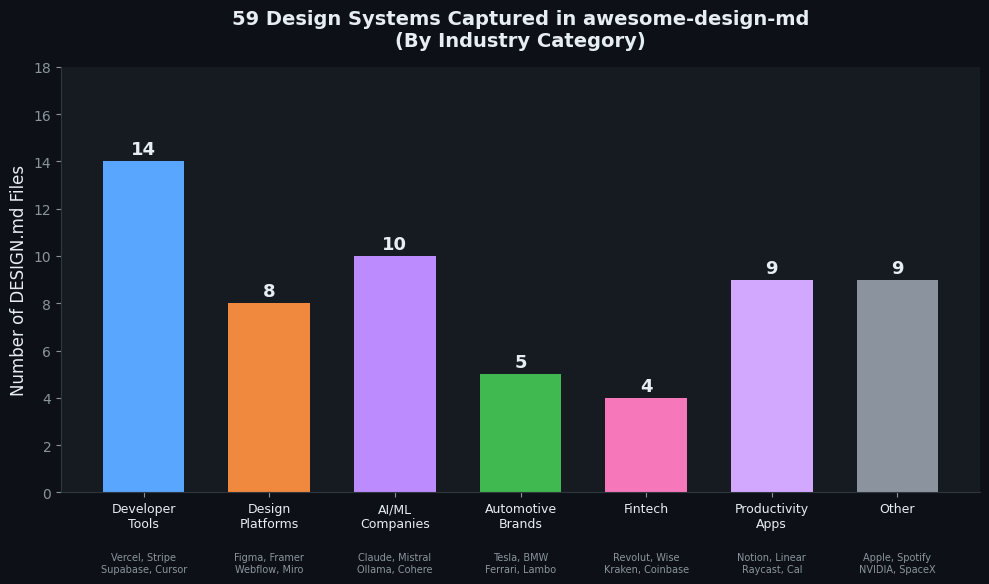
The 59 captured design systems span developer tools (Vercel, Stripe, Supabase), AI companies (Claude, Mistral, Cohere), automotive brands (Tesla, BMW, Ferrari), fintech (Revolut, Coinbase), and productivity apps (Notion, Linear, Raycast).
The Speed: Faster Than Any Awesome List in History
To understand how unusual awesome-design-md's growth is, compare it to the most successful awesome lists at similar ages:
| Repository | Stars in First Month | Created |
|---|---|---|
| VoltAgent/awesome-design-md | 35,082 in 10 days | Mar 31, 2026 |
| awesome-react | ~3,200 in first month | 2014 |
| awesome-go | ~2,100 in first month | Jul 2014 |
| awesome-python | ~1,800 in first month | Jun 2014 |
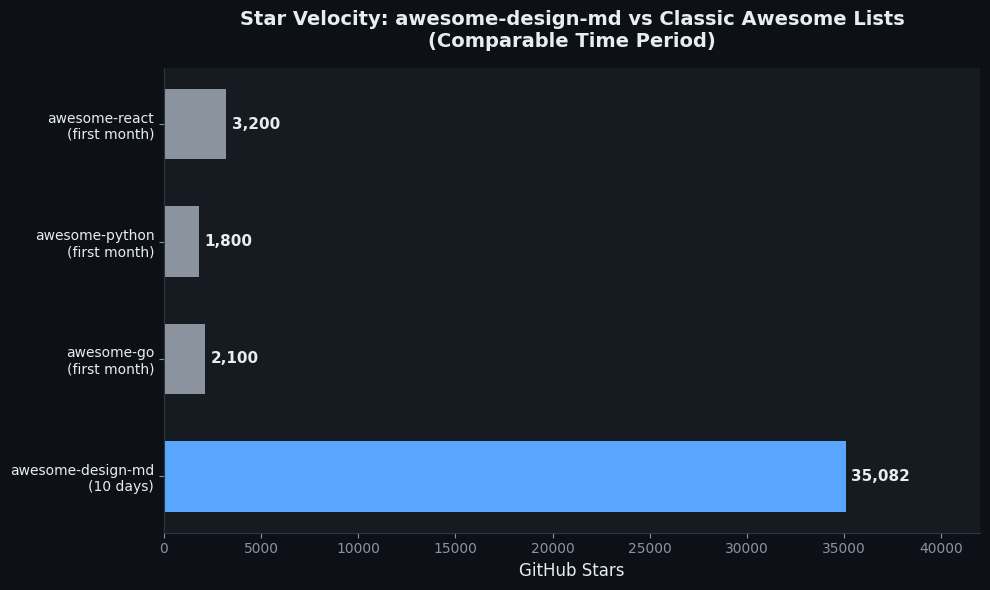
That's roughly 10× the velocity of classic awesome lists that went on to become foundational resources with 100K+ stars. And it happened in a third of the time.
A caveat on star velocity comparisons: GitHub had ~10M users in 2014 versus ~150M+ in 2026. Star culture has changed — one-click starring from trending pages, social media amplification, and bot-driven stars all inflate modern numbers. A fairer comparison would normalize for active user base. Even with that adjustment, awesome-design-md's growth is exceptional — but the 10× headline overstates the gap.
The fork ratio tells an even more interesting story: 4,415 forks on 35,082 stars = 12.6% fork rate. For comparison, awesome-go has a 7.8% fork rate and awesome-python sits at 9.5%. A higher fork rate means people aren't just bookmarking — they're actively using and modifying the files.
The Bigger Pattern: Markdown as the Agent Protocol Layer
DESIGN.md didn't emerge in isolation. It's the latest addition to a growing family of .md files that serve as the communication protocol between humans and AI agents:
| File | Who Reads It | What It Defines | Top Repo | Stars |
|---|---|---|---|---|
DESIGN.md | Design agents | How the project should look | awesome-design-md | 35,082 |
AGENTS.md | Coding agents | How to build the project | agents.md | 19,914 |
CLAUDE.md | Claude Code | Agent behavior & preferences | awesome-claude-code | 37,590 |
SKILL.md | Agent runtimes | Reusable agent capabilities | awesome-claude-skills | 10,849 |
SOUL.md | Agent persona | Personality & communication style | Convention, no dominant repo yet | — |
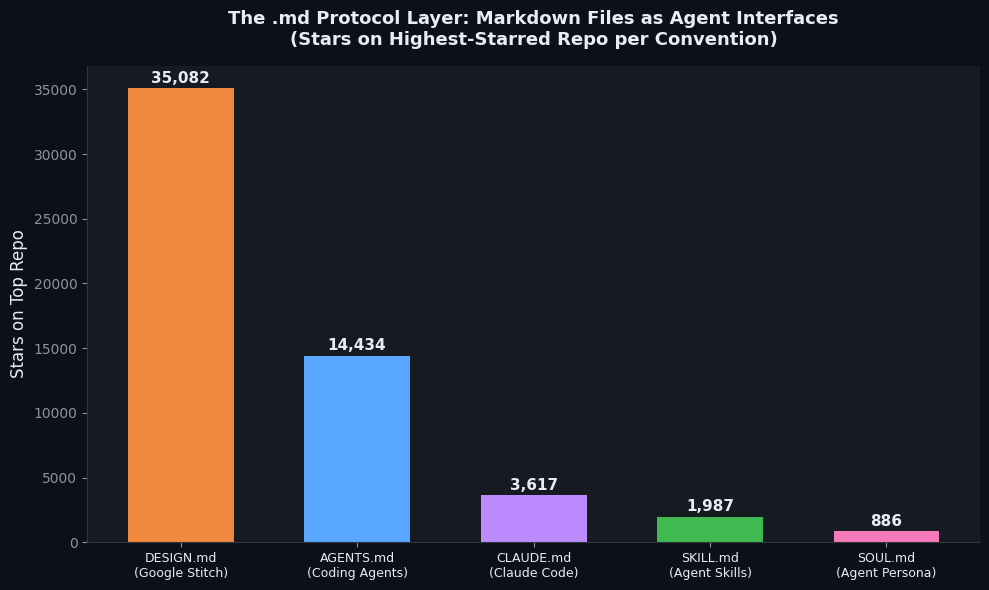
This is a pattern worth naming: the .md Protocol Layer.
Each file follows the same formula: a plain-text document at the project root, read by AI agents to understand one specific dimension of the project. Together, they form a complete specification — not for machines (that's what APIs are for), not for humans (that's what docs are for), but for the new category in between: AI agents that need to understand human intent.
Why markdown? Three reasons:
- LLMs read markdown natively. No parser needed. No schema validation. The format is the format LLMs were trained on.
- Humans can read and edit it. Unlike JSON schemas or YAML configs, markdown is comfortable for non-engineers — including designers.
- Git-native. Version control, diffs, PRs, blame — all the collaboration patterns already work.
The Google Stitch Catalyst
Google Stitch launched as an AI design tool, but its biggest contribution might be standardizing the DESIGN.md format. Before Stitch, there was no consensus on how to describe a design system to an AI agent.
The ecosystem that formed around it within days tells the story:
| Repo | Stars | What It Does |
|---|---|---|
| VoltAgent/awesome-design-md | 35,082 | Curated DESIGN.md collection |
| kzhrknt/awesome-design-md-jp | 263 | Japanese/CJK DESIGN.md extensions |
| Kargatharaakash/stitch-mcp | 95 | MCP server for Google Stitch |
| bergside/awesome-design-md-skills | 53 | Agent skills for DESIGN.md |
| royvillasana/figma-to-ai-prompter | 27 | Figma → DESIGN.md converter |
| albertzhangz10/figma-design-system-to-design-md | 15 | Figma tokens → DESIGN.md |
The Japanese extension is particularly telling. Within 3 days of awesome-design-md's launch, kzhrknt/awesome-design-md-jp appeared — extending the format for CJK typography, something Google Stitch's original spec didn't fully address. That's the kind of organic ecosystem growth that signals a real standard, not just a trend.
Why This Matters: The Design-Code Gap Was the Last Mile
The AI coding revolution has a well-known problem: AI agents can write functional code, but the UI looks generic. Every AI-generated app looks like it was built with the same default Tailwind components — because it was.
DESIGN.md solves this by giving agents the same context a human designer would provide: not just colors and fonts, but philosophy. The "Do's and Don'ts" section, the "Visual Theme & Atmosphere" description — these are the qualitative inputs that make the difference between "technically correct" and "actually good."
Consider the difference:
Without DESIGN.md:
"Build me a dashboard like Linear"
The agent guesses. It picks some blue tones. Maybe it gets close.
With Linear's DESIGN.md:
Visual Theme: "Minimal precision. Every pixel has purpose. Design by subtraction." Colors: Background #0A0A0B, Text #EDEDEF, Accent #5E6AD2 Typography: Inter, -apple-system. Headings 500 weight. Body 400, 14px. Component Style: Rounded-lg corners. Ghost buttons. Keyboard-first interactions.
The agent doesn't guess. It knows.
The Fork-to-Star Ratio: Evidence of Real Usage
Numbers that stand out:
- 35,082 stars — massive discovery and interest
- 4,415 forks — people are actually copying these files into projects
- 254 open issues — active community requesting new design systems
- 59 design systems — from Apple to Zapier, covering the most-cloned UI patterns
The 12.6% fork rate is the key metric. Most awesome lists have fork rates under 10% because people star them as bookmarks. A 12.6% fork rate means roughly 1 in 8 people who discover the repo immediately take action — they copy a DESIGN.md into their own project.
For context, this is higher than the fork rate of most framework repos, where forking implies serious modification intent.
What Comes Next
Three predictions based on the data:
1. DESIGN.md becomes as standard as README.md. The velocity suggests we're past the tipping point. Within 6 months, DESIGN.md at the project root will be as common as .gitignore.
2. The .md Protocol Layer consolidates. Someone will create a meta-standard — a single document that references AGENTS.md, DESIGN.md, SKILL.md, and others. Think of it as package.json for agent context.
3. Design tools pivot to markdown-first output. Figma, Framer, and other design tools will add "Export as DESIGN.md" as a first-class feature. The Figma-to-DESIGN.md converters already appearing on GitHub are the leading indicator.
Explore the Data Yourself
Data verified via GitHub API on April 9, 2026. Star counts are point-in-time snapshots and may differ at time of reading.