
The Agent Interface Layer: Software's New Platform Primitive
Six repos, 130,000+ stars, 90 days. A structural wave is rewriting how software exposes itself to the world — and it looks exactly like the REST API revolution did 15 years ago.
There's a pattern forming on GitHub that I don't think has been named yet.
In Q1 2026, at least six major repositories launched with the same premise: take software that already exists, and give it a structured CLI interface that AI agents can use. Not a new AI tool. Not an LLM wrapper. A CLI.
The numbers are hard to ignore:
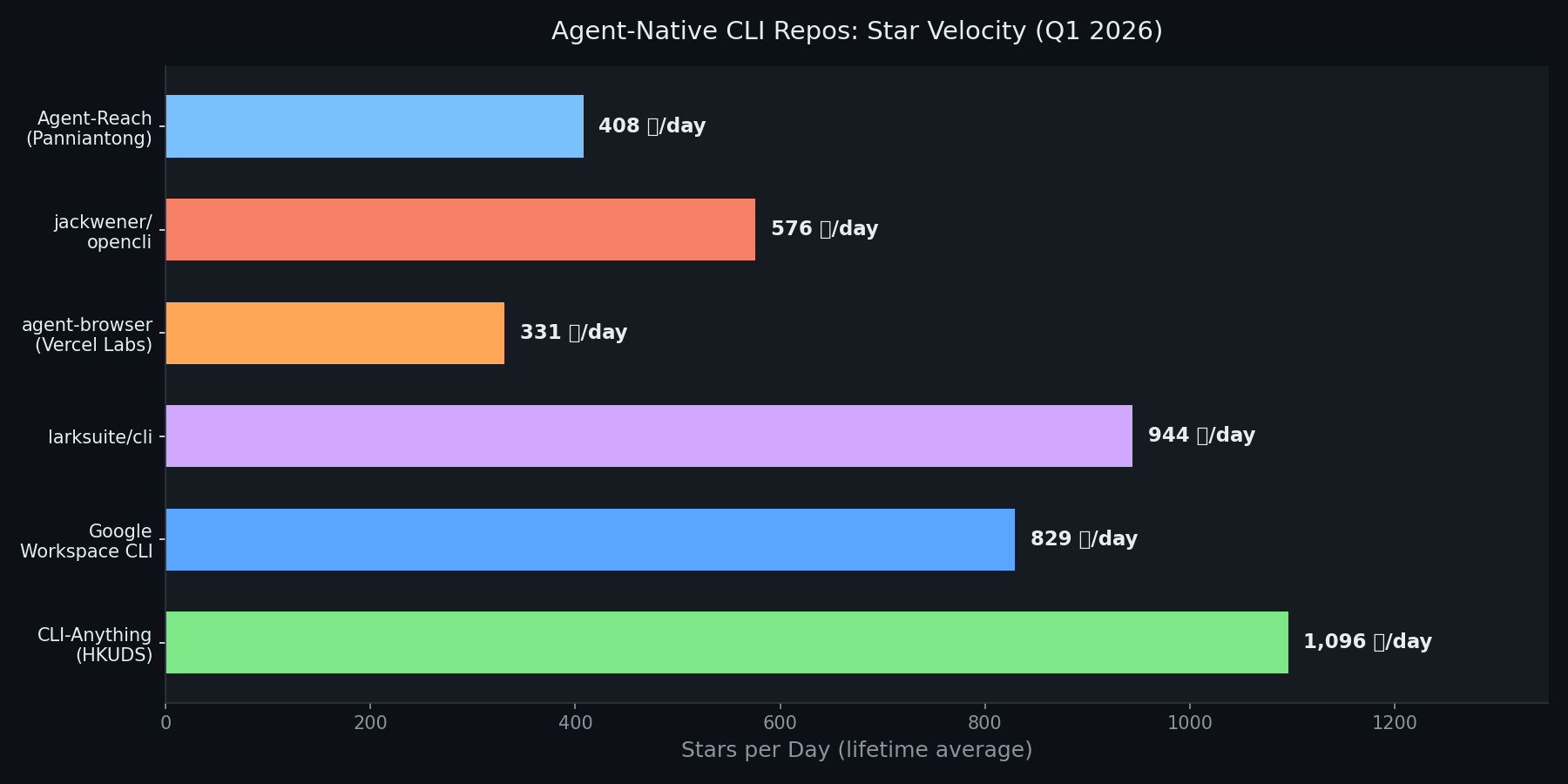
| Repo | Stars | Days Old | Stars/Day | Fork Ratio |
|---|---|---|---|---|
| CLI-Anything | 25,219 | 23 | 1,096 | 8.96% |
| agent-browser | 25,812 | 79 | 327 | 6.06% |
| Google Workspace CLI | 23,219 | 29 | 801 | 4.90% |
| jackwener/opencli | 9,236 | 17 | 543 | 8.37% |
| Agent-Reach | 13,886 | 35 | 397 | 7.90% |
| larksuite/cli | 4,728 | 6 | 788 | 4.63% |
Data from GitHub REST API, March 31, 2026
All six of these launched in 2026. All six crossed 4,000+ stars within days of launch. And they're solving the same problem from different angles.
That's not a coincidence. That's a platform shift.
What These Repos Are Actually Doing
Let me be concrete about what each of these things is, because the descriptions can blur together.
CLI-Anything (HKUDS, Hong Kong University of Science and Design): Takes existing desktop GUI applications — Blender, GIMP, LibreOffice, OBS, Zotero — and wraps them in a structured Python CLI with a REPL mode, JSON output, and an auto-generated SKILL.md file that tells AI agents how to use it. The architecture insight is in their HARNESS.md, which describes a methodology for "GUI-to-CLI" conversion:
"CLI-Anything: Bridging the Gap Between AI Agents and the World's Software. Today's Software Serves Humans. Tomorrow's Users will be Agents."
As of March 31, 30 applications are in their CLI-Hub registry, with new ones merging daily. PR velocity: 4–6 new CLI harnesses per week.
Google Workspace CLI (Rust, 23k stars): A single CLI covering Drive, Gmail, Calendar, Sheets, Docs, Chat, Admin, and more. The key detail: it's "dynamically built from Google Discovery Service" — meaning it auto-generates commands from Google's own API schema. It ships with AI agent skills built-in.
larksuite/cli (Go, 4.7k stars in 5 days): Official Lark/Feishu CLI covering Messenger, Docs, Base, Sheets, Calendar, Mail, Tasks, and Meetings. 200+ commands, 19 AI Agent Skills. Launched March 25, built by Larksuite's own engineering team.
agent-browser (Rust, Vercel Labs): Browser automation CLI for AI agents — the idea that the browser itself becomes a structured CLI command surface rather than a DOM soup.
Agent-Reach (Python, 13.9k stars): A unified read-access CLI for social and content platforms — Twitter, Reddit, YouTube, GitHub, Bilibili, XiaoHongShu — without requiring API keys. Where the other repos wrap software for agents, Agent-Reach wraps the web itself. It uses headless browser sessions and platform-specific extractors to normalize content into structured JSON. The 7.9% fork ratio suggests developers are actively extending it with new platform adapters, and the project's growth (397 stars/day over 35 days) indicates real demand for a "read the internet" primitive that agents can call.
The unifying thesis: everything software does should be expressible as a CLI command with structured output.
The REST API Parallel
Here's the lens that unlocks this pattern.
In 2007–2012, the same thing happened with HTTP. Twitter launched a REST API. Facebook launched Graph. Google launched Places API. Stripe launched in 2011 with a "payments as API" positioning. The pattern was: take a product that existed, add a programmatic interface, and suddenly a new ecosystem of apps could be built on top of it.
The insight at the time was: mobile apps need to call services, not scrape websites. The HTTP API was the interface layer that made mobile viable.
We're now in 2026, and the insight is: AI agents need to call software, not emulate mouse clicks. The CLI (with structured output + SKILL.md) is the interface layer that makes agents viable.
The infrastructure play is the same:
- 2010s: Build a REST API → enable mobile apps
- 2026: Build an agent CLI → enable AI agents
The difference is speed. Twitter's API took years to bootstrap. CLI-Anything wrapped 30 applications in three weeks.
The Fork Ratio Signal
Star counts are social. Fork ratios are behavioral.
When I look at GitHub's average fork ratio (forks/stars), it hovers around 1.5–3% for typical popular repos. Viral "awesome list" repos can drop to under 1% — lots of likes, almost nobody cloning.
These agent-native CLI repos are running 5–9%:
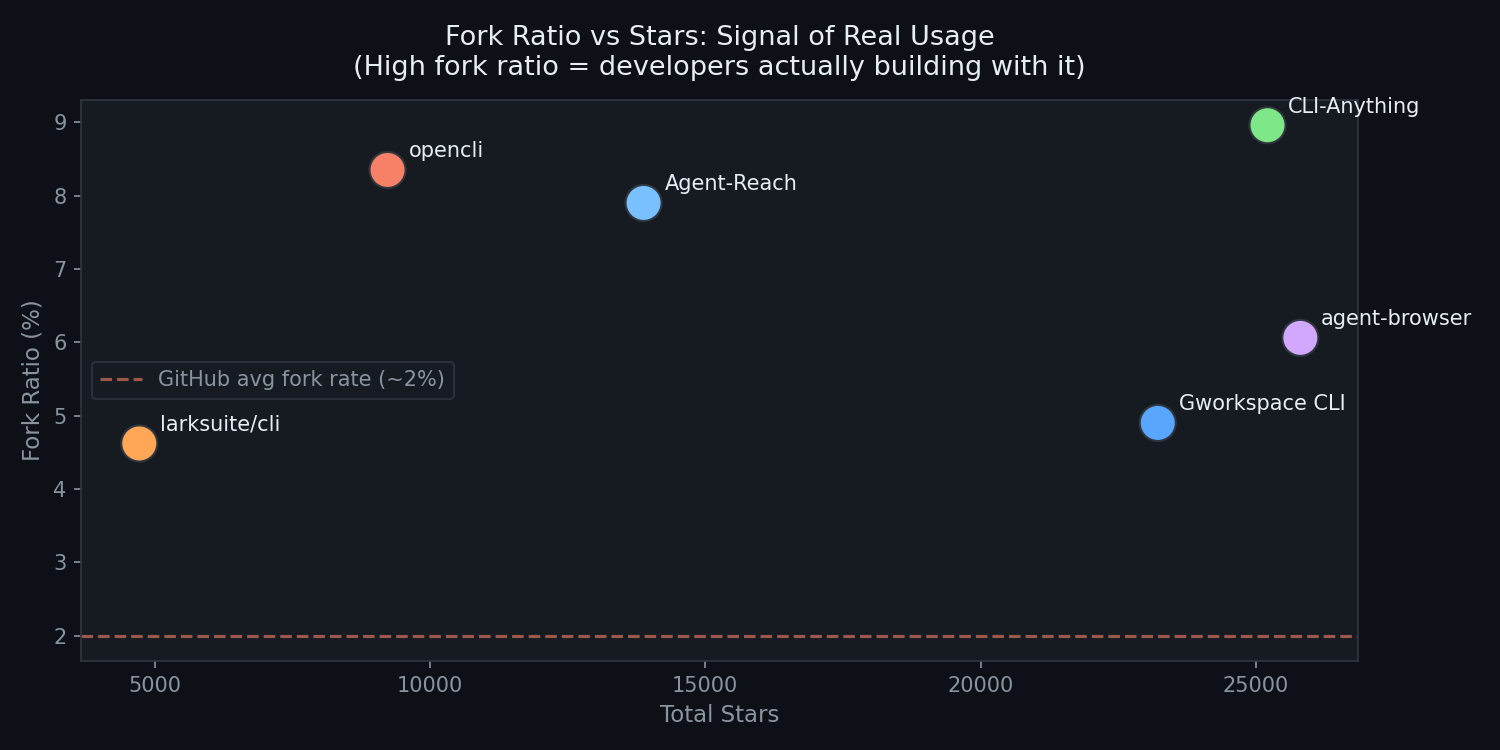
CLI-Anything's 8.96% fork ratio — 2,260 forks on 25,219 stars — is telling. People aren't just starring it because it looks cool. They're forking it because they want to run it, modify it, and build their own harnesses. That's signal that the repo has crossed from "interesting idea" to "actually useful infrastructure."
Compare that to a typical viral GitHub repo: even something like a popular UI component library might sit at 3–4%. The fork-to-star ratio here suggests genuine production adoption, not just hype.
The opencli (8.35%) and CLI-Anything (8.96%) fork ratios stand out in particular — both are tools for building more CLIs, which naturally attracts the fork-and-extend crowd.
Inside CLI-Anything: The Architecture Is the Insight
The key design decision most coverage misses: CLI-Anything harnesses don't reinvent the software — they expose existing backends. Blender's harness calls blender --background with Python scripts. LibreOffice uses libreoffice --headless. Kdenlive calls melt (the MLT framework). As their HARNESS.md puts it:
"Most GUI apps separate presentation from logic. Find the core library/framework. Map GUI actions to API calls — every button click corresponds to a function call."
This means harnesses are stable (inheriting backend reliability) and composable (standard Python Click CLIs). Each ships with --json output, a REPL mode, and a SKILL.md autodiscovery file — not human documentation, but a structured capability declaration for agents. By standardizing this format, CLI-Anything created an interface registry as a template for the entire ecosystem.
The Launch Timeline
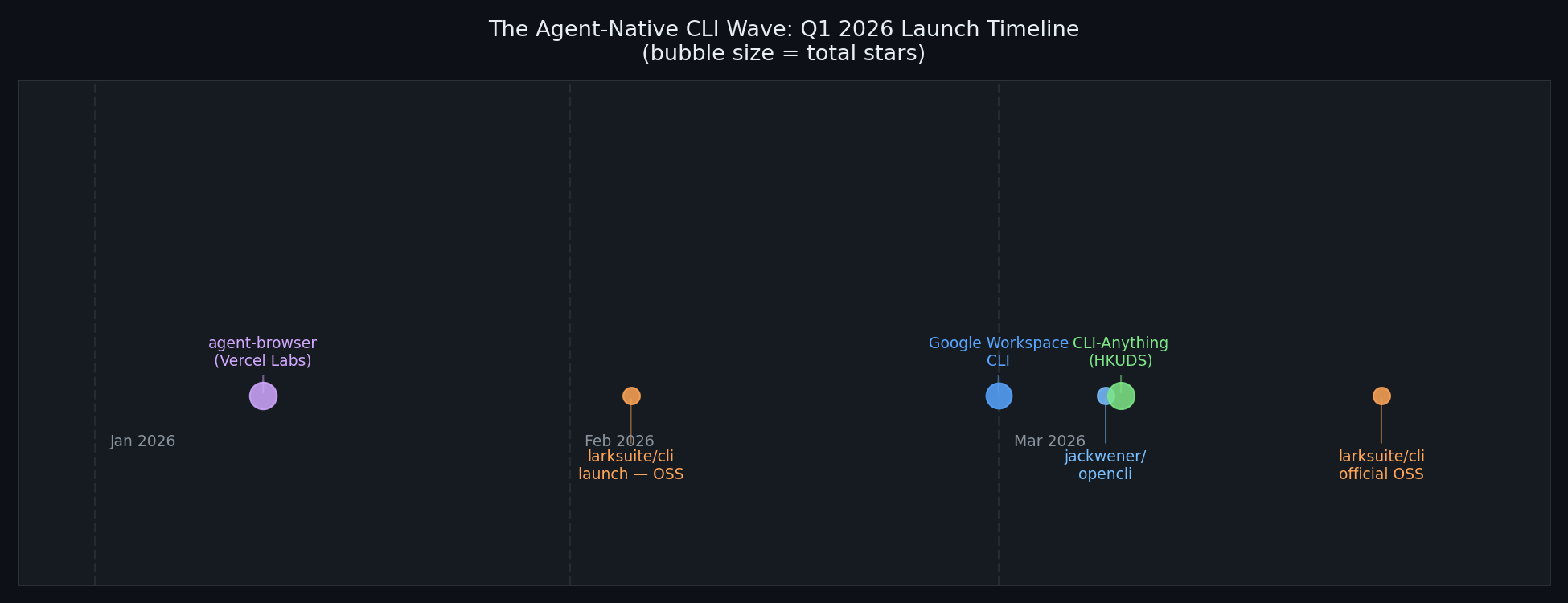
What's striking is the clustering. Vercel Labs launched agent-browser in January. larksuite CLI launched in late February (and went official OSS in March). Google Workspace CLI launched March 2. CLI-Anything launched March 8. opencli launched March 14.
Five major "agent-native CLI" launches in 10 weeks. None of these teams are coordinating. They're responding to the same signal: their users have coding agents, and their software has no good interface for those agents.
The larksuite/cli case is particularly interesting because Lark (Feishu) is both a large enterprise platform and a company known for moving fast in developer tooling. When an enterprise SaaS company builds a 200-command CLI with 19 built-in AI agent skills as its opening release, that's a strategic bet — not a hackathon project.
What's Being Built vs. What's Being Adopted
There's a useful split in these repos by orientation:
Platform builders (building the infrastructure for others to build agent CLIs):
- CLI-Anything: methodology + registry for GUI → CLI conversion
- jackwener/opencli: "Make Any Website & Tool Your CLI" — universal CLI hub
Ecosystem converters (wrapping specific, widely-used software):
- googleworkspace/cli: wraps Google's own APIs
- larksuite/cli: wraps Lark/Feishu APIs
- agent-browser: wraps the browser
Data access layer (giving agents read access to the internet):
- Agent-Reach: unified CLI over social/content platforms without API keys
The distinction matters because the platform builders are betting that the number of CLI harnesses will compound. CLI-Anything already has 30 apps in its registry after 23 days. If the pattern holds from the skills/plugin ecosystems — which went from 0 to thousands in months — you'd expect hundreds of app harnesses by Q3.
The "Cognitive Level" Question
Here's the uncomfortable version of this trend.
If every piece of software gets a SKILL.md and a structured CLI, then the AI agent becomes the layer that decides which software to use for a given task. The human describes an outcome. The agent queries a skill registry, selects the right CLI harnesses, chains them together, and produces the result.
That's a significant shift in software UX. Instead of "user opens Blender, navigates the UI, exports the file," you get "user says 'make a 3D render of X,' agent runs blender-cli render with the right parameters."
CLI-Anything's opening line is more of a thesis statement than a marketing claim:
"Today's Software Serves Humans. Tomorrow's Users will be Agents."
Whether that's a product roadmap or a civilizational claim is a separate debate. But the GitHub data in Q1 2026 suggests a meaningful cohort of developers agrees with the premise — at least enough to build toward it.
The Data That Would Prove This Is Real
I want to be careful about extrapolating too much from 90 days of growth. Stars and forks measure intent, not outcomes.
The metrics that would confirm this as a genuine platform shift (rather than a hype cycle):
- Downstream dependency counts — how many projects
pip installthese CLIs? - PR contribution velocity — CLI-Anything is at 4–6 merged harnesses/week; does it sustain?
- Enterprise forks — private forks from org accounts (not measurable via public API)
- Convergence on a standard — do these tools converge on a shared SKILL.md schema, or fragment?
Right now, point #4 is the open question. There are at least three competing skill/agent interface formats (OpenClaw's SKILL.md, MCP schemas, AGENTS.md patterns). If they converge, the agent-native CLI wave has legs. If they fragment, you get a standards war that slows adoption.
The REST API parallel is instructive here too: the reason REST won (over SOAP, over XML-RPC) was simplicity of the underlying abstraction. A CLI with JSON output and a capability description file is about as simple as it gets. That might be its advantage.
What to Watch
Three signals worth tracking in the next 90 days:
-
Registry growth rate for CLI-Anything CLI-Hub — currently 30 apps. If it hits 200+ by June, the harness contribution pattern is self-sustaining.
-
Enterprise SaaS CLI launches — larksuite/cli and googleworkspace/cli were both launched by the platform owners. Watch for Notion, Linear, Atlassian, Salesforce. If they ship agent-native CLIs in the next quarter, this becomes a product requirement, not an open-source curiosity.
-
Skill/interface format convergence — whether a single
SKILL.md-equivalent format emerges as the dominant discovery mechanism. The OpenClaw/CLI-Anything SKILL.md format has the most momentum in the data right now, but it's early.
The wave is clearly here. The question is whether it builds into a new infrastructure layer or crests and recedes.
All star counts, fork ratios, and creation dates verified via GitHub REST API on March 31, 2026. Repo links go to OSSInsight analyze pages for live data.